While Qatar doesn’t stop screaming and attacking the Arab regimes claiming they are dictators, the mini-state led by Al-Thani don’t ever allow any kind of criticizing the ruling family.
Muting mouths and controlling media and journalism by the ruling family became normal in a state whose rulers say what they do not do.
The administration of the country relies on an iron fist, as it doesn’t let a loophole that will allow anyone to criticize the existing regime, while the prison is devoured by anyone who tries to honestly say his opinion on the land of lies.
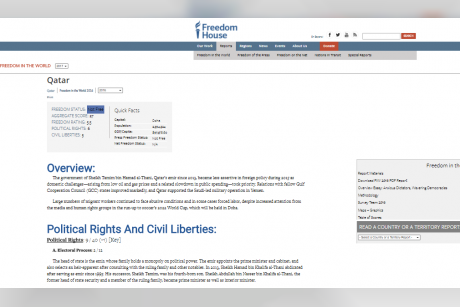
The head of state is the Emir, whose family monopolizes political power. The Emir appoints both the Prime Minister and the Council of Ministers, and also appoints an heir after consultation with the ruling family and other dignitaries.
In 2013, Sheikh Hamad bin Khalifa Al-Thani resigned from his post after being Emir since 1995 and his successor was Sheikh Tamim, his fourth son. Sheikh Abdullah bin Nasser bin Khalifa Al-Thani, the former Chief of State Security and a member of the ruling family, became the Prime Minister as well as the Minister of the Interior.
The constitution, which was passed in a referendum in 2003, stipulates that 30 of the 45 seats in the Shura Council must be filled by elections every 4 years, and the Emir will appoint the other 15. However, the elections have not yet taken place, so all members are currently appointed. Elections scheduled for 2013 were postponed, ostensibly due to transferring power to Tamim.
The country held its first nonpartisan elections in 1999 for a 29-member central council, which is a body designed to advise the Minister of Municipal Affairs and serves for four years. In the last council elections held in May 2015, there were five female candidates out of the 130 candidates, two of them won seats, against one seat in the previous council.
Although voter turnout rose significantly to 70% of registered voters, against 43% in 2011, the actual number fell by 40% to the lowest record of 21,735, of about 150,000 eligible voters.
All Qatari citizens over the age of 18 years are entitled to vote, except those who serve in the army or in the Ministry of the Interior. However, more than 80% of the country's population are non-voting because of being foreign nationals.
The government does not allow political parties to exist, as the ruling family controls the regime and while the majority of the non-citizens work in government jobs and senior judges, they don’t have political rights.
The power of making decisions is just in Tamim and his family’s hands, what means lack of transparency in the government’s procurement, which is claimed to be relying on personal connections.
Qatar was accused of corrupting to win hosting the World Cup 2022 and the official information is generally subjected to strict control, it also ranks 22nd out of 168 countries and territories surveyed in Transparency International's Corruption Transparency Index 2015.
Estimated political rights
Citizens may apply representatives to the local elected governments with limited powers over municipal services. These representatives report to the Ministry of Municipal Affairs and Urban Planning. However, the low registration rate for the municipal elections in 2015 ensured that the public's confidence in the ability of existing institutions to communicate with citizens' concerns declined, especially in the light of the continued lack of elections for the Shura Council.
Freedom of expression and belief
Although the constitution guarantees freedom of expression, the printed and broadcasted media are influenced by the ruling family and subject to State control. The major daily newspapers are privately owned, but their owners and councils include members of the ruling family too.
In 1996, the Emir allowed to establish Al Jazeera, a television network that achieved a global success. Although it’s privately owned, the government paid for operating the network since its establishment. All journalists in Qatar have a high degree of self-censorship and face possible prison sentences for defamation and other press offenses.
Foreign journalists encountered official interference during 2015. In March, a German public broadcasting news crew that was filming a documentary on World Cup corruption was detained by authorities for 14 hours. In May, a British Broadcasting Corporation (BBC) news crew was detained for two days while investigating conditions for migrant workers. Both teams were subjected to travel bans lasting several days and had their equipment confiscated.
A 2014 law on cybercrimes prescribes up to three years in prison for a range of vaguely worded offenses, including online dissemination of “false news” or content that undermines “general order.” Publishing personal or family information can draw prison time and fines even if the content is accurate. The government censors online content and blocks access to websites that are deemed pornographic or politically sensitive.
Islam is the official religion, though the constitution explicitly provides for freedom of worship. The Ministry of Islamic Affairs regulates clerical matters and the construction of mosques. Several churches have been built for Qatar’s growing Christian community. The constitution guarantees freedom of opinion and academic research, but scholars often self-censor on politically sensitive topics. Several foreign universities have established branches in Qatar under a program to strengthen the country’s educational institutions.
While residents enjoy some freedom of private discussion, security forces reportedly monitor personal communications, and noncitizens often self-censor to avoid jeopardizing their work and residency status.
Associational and Organizational Rights
While the constitution grants freedoms of assembly and association, these rights are limited in practice. Protests are rare, with the government restricting the public’s ability to organize demonstrations. All nongovernmental organizations need state permission to operate, and the government closely monitors their activities. There are no independent human rights organizations, though a government-appointed National Human Rights Committee, which includes members of civil society and government ministries, investigates alleged abuses.
A 2005 labor law expanded some worker protections, but the rights to form unions and to strike remain restricted. The only trade union allowed to operate is the General Union of Workers of Qatar, which prohibits membership for non citizens, government employees, and household workers. Onerous administrative and financial requirements deter the formation of professional associations.
Rule of Law
Despite constitutional guarantees, the judiciary is not independent in practice. The majority of Qatar’s judges are foreign nationals who are appointed and removed by the emir. The judicial system consists of Sharia (Islamic law) courts, which have jurisdiction over a narrow range of issues including family law, and civil law courts, which have jurisdiction over criminal, commercial, and civil cases.
Although the constitution protects individuals from arbitrary arrest and detention and bans torture, a 2002 law allows the suspension of these guarantees for the “protection of society.” The law empowers the interior minister to detain a defendant for crimes related to national security on the recommendation of the director general of public security.
The integrity of Qatar’s judicial system became the focus of attention in October 2015, when the Court of Appeal overturned convictions of involuntary manslaughter for several people, including a member of the ruling family, in connection with the 2012 Villaggio Mall fire, which killed 19 people. Qatar’s attorney general announced plans to appeal the decision, which critics said reflected bias in favor of the defendants.
Personal Autonomy and Individual Rights
Qataris face no apparent restrictions on freedom of movement within Qatar or on type or place of employment. Such freedoms, however, are not extended to noncitizens and foreign workers. Unlike citizens, non citizens must pay for services including education and utilities, and face discrimination in housing and other areas. Qataris are permitted to own property and start private businesses, although the process of obtaining necessary commercial permits can be cumbersome. Noncitizens are generally barred from owning property.
While the constitution treats women as full and equal persons, and gender-based discrimination is banned, women face de facto discrimination in the workforce. In 2006, Qatar implemented a codified family law to regulate issues such as inheritance, child custody, marriage, and divorce. While the law expanded protections for women, they continue to face disadvantages, including societal discrimination, and have few effective legal mechanisms to contest incidents of bias.
Domestic violence is not specifically criminalized, though the 2011–16 National Development Strategy included plans for laws against domestic violence, increased legal protections for victims, and robust social support services. The Qatar Foundation for Child and Women Protection operates a shelter for abused women and children and, in cooperation with the public prosecutor’s office, facilitates the legal response to cases of abuse. However, it is unclear how many domestic abuse charges were filed in 2015.
Many foreign nationals, who make up over 90 percent of the workforce, face economic abuses including the withholding of salaries, contract manipulation, poor living conditions, and excessive working hours. However, fear of job loss and deportation often prevents them from asserting their limited rights. Female household workers are particularly vulnerable to abuse and exploitation. Migrants building the infrastructure for the 2022 World Cup continued to work in harsh conditions. There have been reports of workers not receiving wages for more than a year and being stranded in Qatar after the collapse of the contracting companies that employed them.